
Sustainability

Industrial expertise meets climate protection expertise.

Implement together.

Creating added value.

That is our motivation.

Has non-financial reporting already been carried out?
And what are the next steps?

Together with our cooperation partner ClimatePartner, we want to enable a quick and cost-effective entry into this area. For us, calculating the CO2 footprint , developing the sustainability strategy, and actually preparing and approving the report by independent third parties are just the first steps.

Our expertise lies primarily in supporting your company in developing and effectively implementing decarbonization plans – including the necessary or possible measures related to buildings, machinery, and labor. A successful decarbonization plan requires minimizing all waste within the company, which can often lead to an improvement in business results.


Interested but don't feel like reading? Just contact me, I'm happy to help by phone or email.

Till Zöhrer

+43 676 970 41 14
This email address is stez protected from spambots. You need javaScript Enabled to view it.
Sustainability considerations must be directly integrated into concept development and product creation. Only in this way can future compliance with customer, market, and legal requirements be ensured.

A key factor in successfully implementing a sustainability culture is to specifically inform your employees about this topic and actively involve them in its implementation. Our academy offers the necessary tools for this.

CSRD - the Corporate Sustainability Reporting Directive (CSRD)

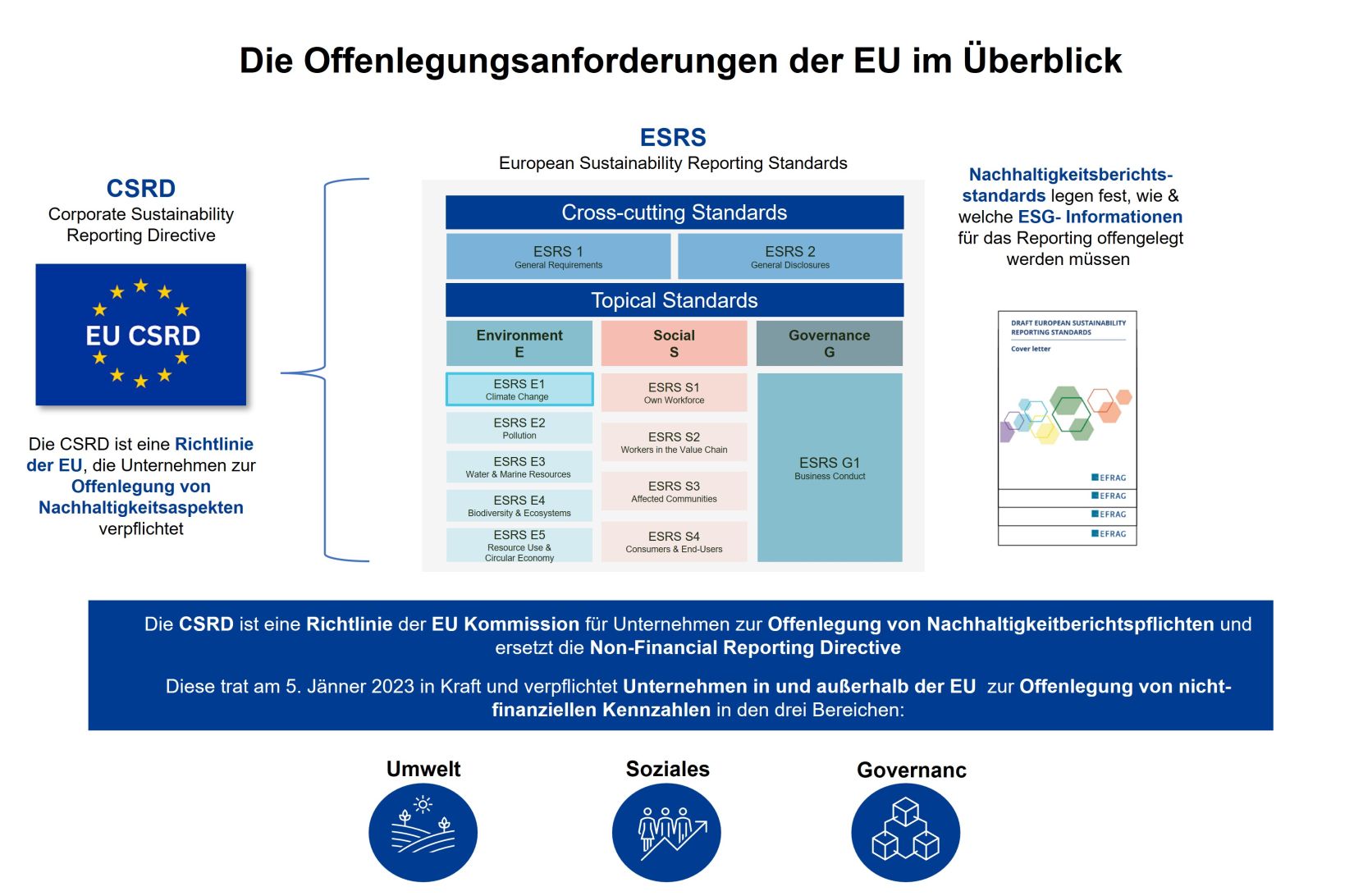
The CSRD was enacted by EU legislation (EU) on 5 January 2023 and requires EU companies - including EU subsidiaries of non-EU companies - to report the environmental and social impacts of their business activities.

CSRD reporting is based on the concept of dual materiality – this means that companies must report on both material and financial impacts:

  • Impact on materiality: Impacts that companies have on sustainability issues (e.g. CO2 footprint , employee rights, respect for human rights, …)
  • Financial impact: The effects that sustainability issues have on companies' finances (e.g., liquidity, loss/profit, access to financing, risk, ...)

CSRD reports must be publicly available, and the CSRD requires third parties to verify the completeness of all disclosures.

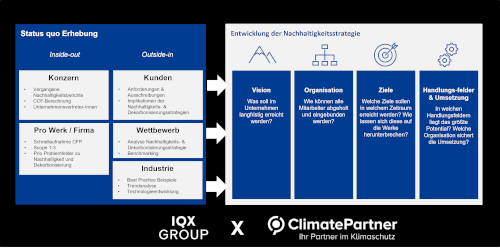
Image: Our approach to the holistic implementation of the sustainability strategy in your company

Which companies must comply with the CSRD?

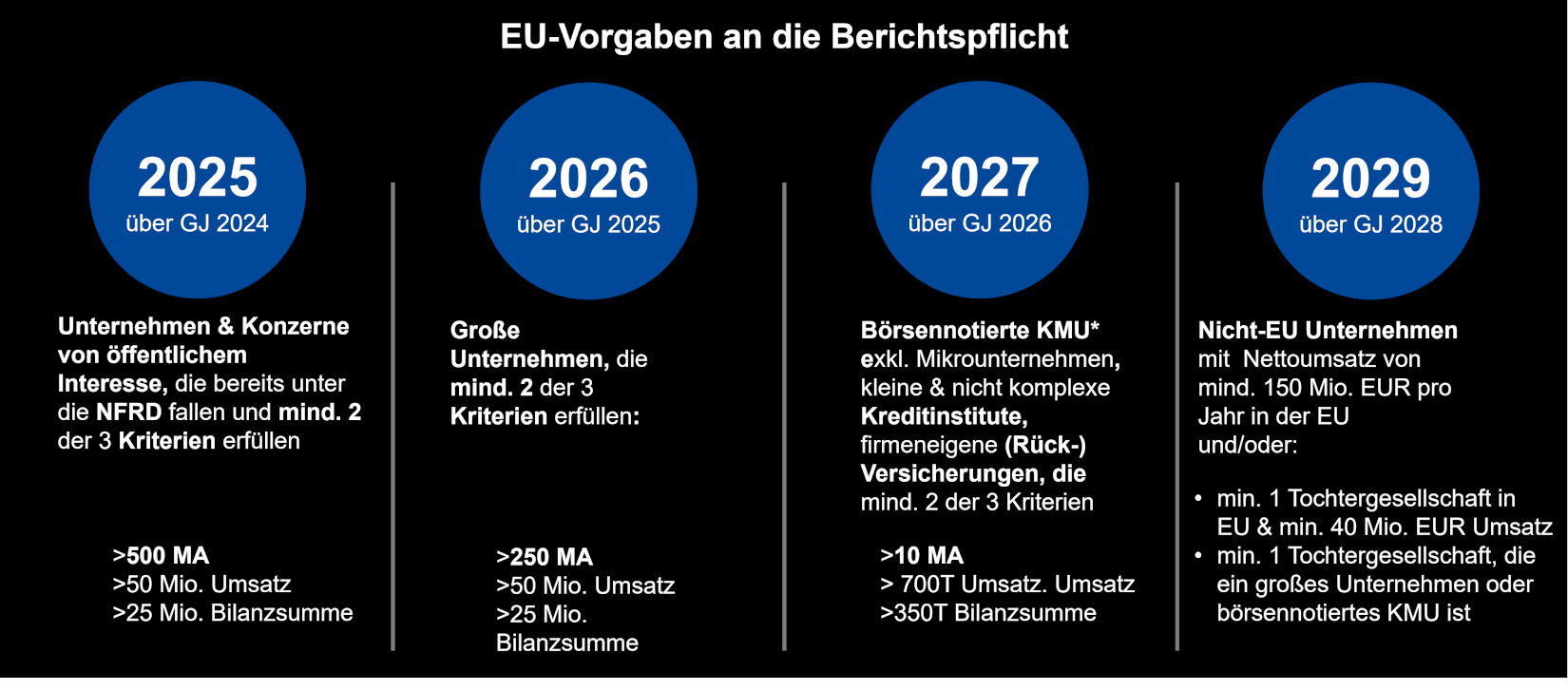
EU legislation has prescribed the following step-by-step plan for companies in the EU regarding the reporting obligation on SUSTAINABILITY by financial year.
CSRD reporting standards and disclosure requirements

The CSRD reporting standards and disclosure requirements are regulated by the European Sustainability Reporting Standards (ESRS). The ESRS describes which key performance indicators and content related to sustainability companies must report.

There are a total of 12 ESRS, which describe information on sustainability issues in four categories:

  • Category 1 – Cross-section: General principles and general information.

  • Category 2 – Environment : Climate change, pollution, water and marine resources, biodiversity and ecosystems, resource use and circular economy.

  • Category 3 – Social : Self-employed workers, employees in the value chain, affected municipalities, consumers and end users.

  • Category 4 – Governance : Business business.

Reporting on the cross-cutting standards, as well as ESRS E1 "Climate Change" and ESRS S1 "Own Workforce," is mandatory for all companies. All other standards must be reported if they are considered relevant to the company.

The ESRS basically covers the following topics:

Sustainability policy

Companies must outline specific policies regarding a range of sustainability issues – environmental protection, treatment of employees, corporate and company diversity, social responsibility, human rights, anti-corruption and anti-bribery – and describe the company's internal procedures for monitoring and enforcing these policies.

Sustainability goals

Companies must develop and report on their sustainability targets, progress towards achieving their targets and how these targets align with a transition to a sustainable economy in general and with achieving net-zero emissions by 2050 in particular (as stipulated by existing EU legislation).

Value and supply chains

Companies must disclose their process for identifying the social and environmental impacts in their value chains and supply chains.

Sustainability risks

Companies must document the risks that various sustainability issues (e.g., climate change, use of fossil fuels, or dependence) pose to the company.

Get involved in corporate sustainability and actively contribute to future-proof development. Take advantage of the opportunity to find an efficient and cost-effective entry point into this field together with us and our partner ClimatePartner.

Our comprehensive approach goes beyond CSRD requirements. We offer not only support in calculating the CO2 footprint and developing a sustainability strategy, but also expertise in the rapid implementation of decarbonization plans from the product development process to the finished product.

Ensure compliance with legal requirements and strive for continuous improvement. A sustainability-oriented corporate culture can support the environment and is also key to long-term success. Are you interested in the comprehensive integration of a sustainability strategy? Then get in touch with us.