The product development process (PDP) is intended to ensure a standardized processing of projects for the development of new products, systems and machines.
The product development process (PDP), often also known as the product realization process, product development process, product industrialization process, or NPI process (New Product Implementation), describes the path from the product idea to the series launch of a product. It encompasses all activities necessary to develop a product according to its requirements, to produce it under quality conditions, and ultimately to deliver it.

Your contact:
Mathias Pflügl
+43 664 96 71 262 This email address is stez protected from spambots. You need javaScript Enabled to view it.
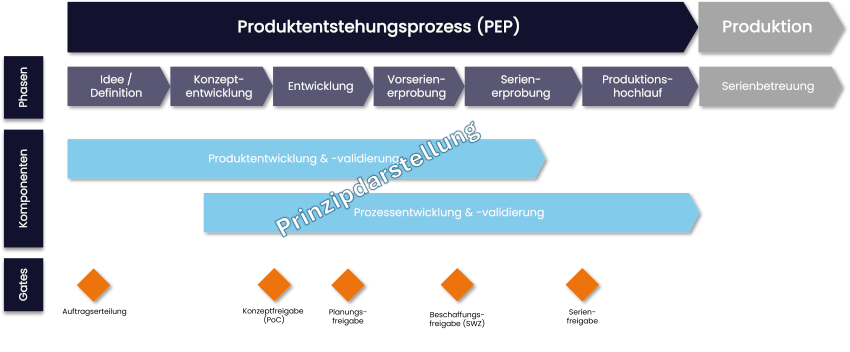
Product Engineering Process (PEP) originated in the automotive industry and is derived from the VDA maturity model. It is also strongly based on the Advanced Product Quality Planning (APQP) model. It structures the simultaneous process of product and process development, as well as the implementation of the manufacturing process in the production environment, including support during the production and delivery ramp-up.
The specific form of the product development process (PDP) can vary significantly from company to company and has different points of connection within the process model. For example, the PDP may be closely intertwined with the innovation process, the pre-development or concept development process, and also with the sales process. During the phase-out phase, it may become strongly intertwined with the production process.
The product development process is based on a phase model whose process phases are mostly subdivided by process or quality gates.
The PEP (Product Engineering Process) is characterized by the fact that it involves almost all business areas of a development-oriented organization. It forms a central guideline for the entire development organization and creates numerous interfaces with business functions as well as with other support processes, which simultaneously presents one of its greatest challenges.
In most process maps, the PEP is at the center of the process model.
The following processes typically have direct interfaces to the PEP.
Concept or pre-development process
Sales and quotation process
Production process
Project management process
Product development process
Change management process
Procurement process
Product release process
Supply chain process
We at IQX GROUP advocate for the development of such standardized product development plans for all highly "project-oriented companies." However, we have often observed that a product development plan based solely on milestones carries certain risks and often results in the project goals not being met.
Causes we observed:
The status of the results to be reported at the milestones is rated as "green" for a long time and suddenly turns "red" shortly before implementation
The time periods between milestones are too long, and potential deficiencies are recognized too late.
The project team starts working on deliverables for the next milestone far too late.
The potential of weekly project coordination meetings as a driver of progress is not being utilized; instead, there are frequent coordination meetings with little "added value" rather than working meetings with concrete results (e.g., managing open issue lists!)
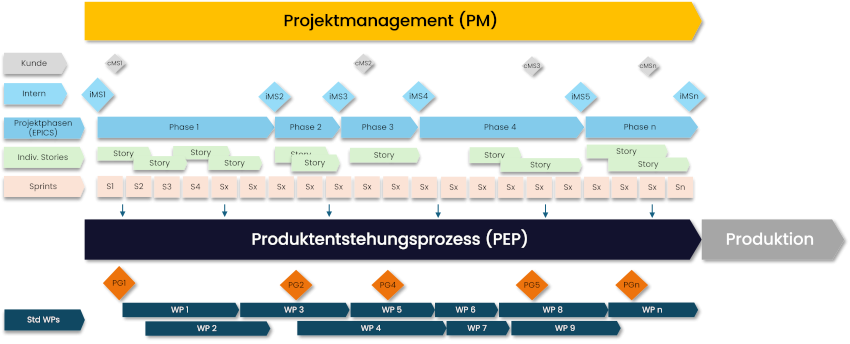
To counteract these four causes, we at IQX GROUP see “SPRINTS” between milestones as a very important component that can be excellently integrated into the classic milestone plan.
Sprints, derived from agile methods, are short, time-limited periods in which a specific set of tasks or goals is completed.
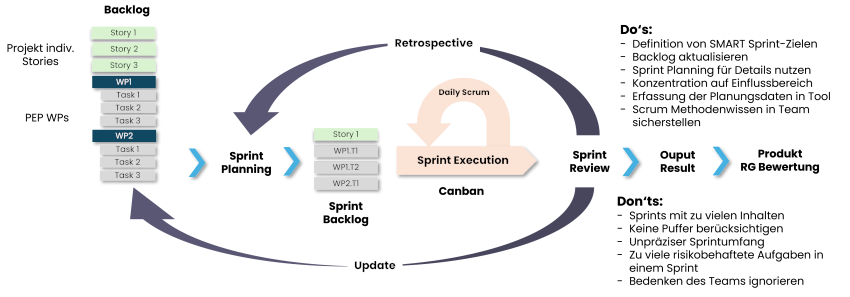
Sprints can effectively support a milestone plan
1. Improved focus and prioritization between milestones
Sprints divide the project into more manageable parts, allowing teams to focus on specific key tasks within a defined timeframe.
By aligning sprint goals between milestones, teams can prioritize tasks that are crucial for achieving the next milestone or the overall project goals. This also results in a manageable number of "sprint topics," maximizing focus on the most critical project content.
2. Regular progress checkpoints
Sprints provide regular intervals for evaluating "honest" progress. At the end of each sprint, teams review concrete results and assess what has been achieved. This helps to identify deviations from the plan early on.
Our approach is to use the standard project coordination process for this. This results in much more professional preparation for the (weekly) project coordination meetings and also adds significantly more value to them.
This frequent review process ensures that milestones are approached methodically and that adjustments can be made in a timely manner to stay on track.
3. Improved adaptability
Agile project management is based on the fundamental principles of responding quickly to changes and prioritizing people and their collaboration. New information or modified requirements may arise during the course of a project. Sprints allow teams to adapt quickly to these changes and adjust their approach accordingly, without derailing the overall milestone plan. This flexibility ensures that the project remains aligned with its goals and stakeholder expectations.
4. Incremental deployment and validation (the agile control loop)
By delivering work in increments, sprints enable continuous validation of progress on critical issues. Each sprint produces a potentially deliverable product increment that can be reviewed by stakeholders. This continuous feedback loop ensures that the project meets desired standards and requirements, thereby reducing the risk of significant problems at milestone checkpoints.
5. Improved teamwork and motivation
The sprint framework promotes regular communication and collaboration within the team. Daily stand-ups, sprint planning, and retrospectives foster a team environment where team members are constantly aligned on key project goals. This collective effort and regular interaction help maintain team motivation and ensure everyone is working toward milestone objectives.
6. Clear and measurable results at short intervals
Each sprint culminates in a tangible result. Agile methods thus allow for the determination of velocity and make the project team's performance measurable. Combined with an objective product maturity assessment, results-oriented project progress against defined targets can be precisely tracked, ensuring that the project is progressing as intended. It also provides stakeholders (project sponsor, customer, project steering committee, etc.) with visible and measurable evidence of progress, increasing transparency and trust.
Integration of sprints into product development projects
To effectively integrate the agile sprint method into classic project plans, you should consider the following best practices from the IQX experts:
Define clear deliverables at each milestone
Define clear and achievable milestones that are linked to specific and measurable deliverables and aligned with the overall project goals. Ensure that the deliverables at each milestone are consistently known and understood by the project team.
Sprint Planning Alignment
Actively involve the project team in sprint planning. This ensures realistic planning and empowers the team to take ownership of achieving the goals. During sprint planning, select tasks that are both crucial to the project's success and contribute to fulfilling the deliverables at the next milestone. Avoid adding too many tasks to the sprint – this would obscure the clear prioritization of the most important issues.
Standup meetings, sprint reviews and sprint retrospectives
Regular progress monitoring within a sprint is conducted through frequent stand-up meetings. These meetings create internal team transparency regarding progress, current activities, and problems.
At the end of a sprint (maximum duration 1 month), a sprint review is held in which the sprint results are presented to the key stakeholders. This ensures that the progress of the most important project topics remains transparent and that stakeholders can make adjustments based on the most important project goals. If they include a product maturity assessment in the sprint review, they receive regular, objective evaluations of the progress toward product realization.
The Sprint Retrospective focuses on team collaboration and the use of tools and resources. The goal is to derive improvement measures for the next sprint.
Do not mix these three different methods, as each meeting serves a different purpose.
Stakeholder engagement
Keep stakeholders informed by including them in sprint reviews. This ensures their feedback is taken into account and they are kept up-to-date on progress towards milestones.
Sprints perfectly complement classic project management milestone plans by offering a structured, adaptable and focused approach to achieving project goals.
By leveraging the strengths of sprints – such as regular progress checks, adaptability, incremental delivery and improved collaboration – project teams can ensure that milestones are achieved efficiently and effectively, ultimately leading to the successful completion of the project.